

If you follow women's health news, you may have already seen it: PCOS, polycystic ovary syndrome, now has an official new name, PMOS. This isn't just a shuffle of letters. Behind the change lies a medical decision more than a decade in the making, designed to better describe a condition that affects around one in ten women of reproductive age, and an estimated 170 million worldwide, according to the Endocrine Society.
So, should you be worried? No. This new name doesn't change your diagnosis or your care. But it says something important about a condition that has long been misunderstood. In this article, we'll look at what the shift from PCOS to PMOS means, why doctors wanted to move on from the old term, and what it actually changes in your day-to-day life and in your relationship.
An official name change, confirmed in 2026
The renaming was published on 12 May 2026 in the leading medical journal The Lancet, and announced at the European Congress of Endocrinology in Prague. The new name agreed by consensus is polyendocrine metabolic ovarian syndrome, shortened to PMOS.
This wasn't a snap decision. It came out of a global consensus process that gathered responses from more than 14,300 people living with the condition and health professionals from every world region, alongside 56 academic, clinical and patient organizations. What stands out is that the people affected had a real say: more than half of those who helped choose the name lived with the condition themselves.
Why drop the word "polycystic"
The old name had a genuine flaw: it was misleading. The term "polycystic ovaries" suggests the condition comes down to cysts on the ovaries. It doesn't.
What imaging shows in many affected women isn't cysts in the medical sense, but small immature follicles, normal structures the ovary produces that here don't always complete ovulation. More surprising still, some women who are diagnosed show no visible ovarian changes at all. The word "cysts" painted a false picture, and that confusion contributed for years to delayed diagnoses and to care focused on the ovary alone, while the rest was overlooked.
Because PCOS, now PMOS, is far more than an ovary story. It's a complex hormonal and metabolic condition that affects several of the body's systems at once.
What PMOS means, word by word
The new name was built to reflect the reality of the condition. Each term earns its place:
Polyendocrine: the condition involves several interacting hormones, not just one. Insulin, androgens and the hormones that regulate the cycle are all part of a disturbed balance.
Metabolic: it often comes with insulin resistance and a higher risk of type 2 diabetes and cardiovascular disease. This dimension, long underestimated, is now front and center.
Ovarian: the link with ovulation and fertility remains central. Ovulation problems are why the syndrome is one of the leading causes of female infertility.
One detail matters: the acronym PMOS stays visually close to PCOS. That was deliberate. Experts wanted a name that was medically accurate without erasing overnight a term millions of women have known and used for years.
What doesn't change for you
This is probably the most reassuring part. If you already live with PCOS, the new name doesn't change your diagnosis, your treatment or your follow-up. You don't need to repeat any tests or book new appointments because of it.
To give everyone time to adjust, both terms, PCOS and PMOS, will coexist during a three-year transition period, until 2028. Your doctor may use either one, and both refer to exactly the same thing. The symptoms you know stay the same: irregular cycles, excess hair growth, acne, or difficulty conceiving for some.
Living with PMOS, together
A name change can feel abstract, but it carries a message that concerns you directly: PMOS is not "just a period problem." It's a chronic condition that touches metabolism, hormones and fertility, and one that often weighs, quietly, on a couple too.
Unpredictable cycles, treatments, the sometimes long wait for a pregnancy: all of this creates a mental load that the person affected rarely carries alone without it touching the relationship. This is where an informed partner makes a real difference. Understanding that PMOS reaches well beyond the ovary means you stop minimizing it and become genuine support, in medical appointments and in everyday life.
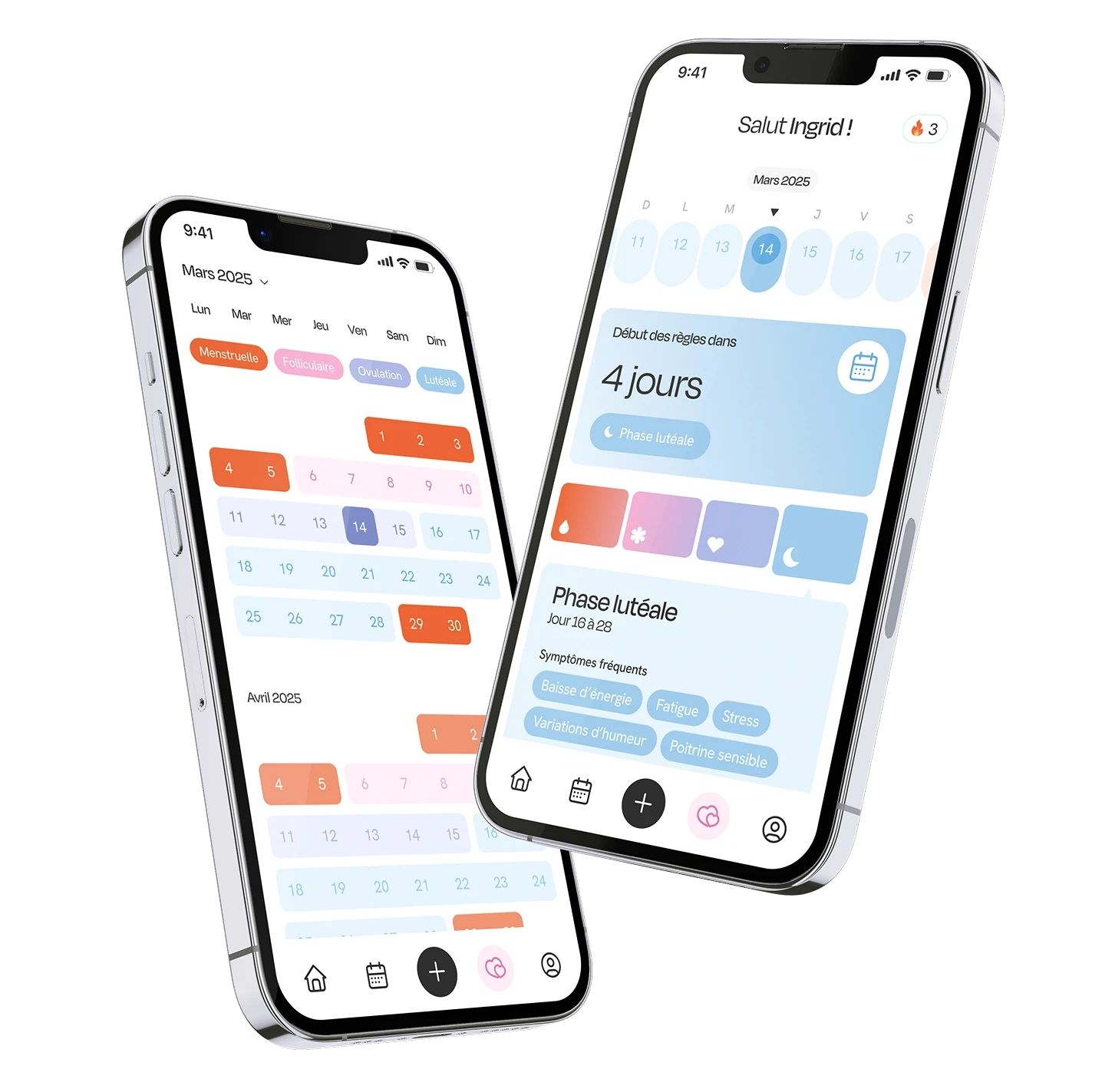
Tracking cycles and symptoms together also helps you see more clearly. Spotting irregularities, noting recurring signs, arriving at an appointment with real data rather than vague memories: that's often what helps you move forward faster. And it keeps either of you from feeling alone with the condition.
If fertility is on your mind, you may also find our article on endometriosis and relationships useful, as it explores intimacy and the question of children from a similar angle.
Frequently asked questions
Are PCOS and PMOS the same condition?
Yes, exactly the same. PMOS (polyendocrine metabolic ovarian syndrome) is simply the new official name for PCOS. What changed is the name, not the condition itself.
Do I need new tests because of the name change?
No. The renaming involves no new tests and no new appointments. Your diagnosis and your care remain valid as they are.
Why was PCOS renamed?
Because "polycystic ovaries" was misleading: it implied cysts that are actually immature follicles, and it reduced the condition to the ovary when it is also hormonal and metabolic. PMOS describes that reality more accurately.
How long will the term PCOS still be used?
Both terms will coexist during a three-year transition, until 2028, while clinical guidelines, training and medical coding systems are updated.
Does PMOS affect fertility?
It can make ovulation harder and is among the leading causes of female infertility. That doesn't mean pregnancy is impossible: many women conceive, naturally or with medical support.
Sources: Endocrine Society — The Lancet
Understanding your body is already a big step. Sharing it with the person who matters is another. With Wenly, you can track your cycle and symptoms together, so your partner knows how you're doing without having to ask, and so every medical appointment starts from a clear picture.