

Fertility
Ovulation Test: When and How to Use It
Ovulation test: when to start, how to read the result and what to do as a couple after a positive. Clear, sourced guidance for trying to conceive.

Your cycle is 28 days, you have heard about "day 14", and the right moment still seems to slip by. An ovulation test swaps the guesswork for a measurement: it picks up, in your urine, the rise of a hormone called LH that comes just before ovulation.
This guide covers how it works, when to start, how to read the result and what it cannot tell you. It is written for two people trying for a baby: the test gives a signal, and you decide together what to do with it.
How does an ovulation test work?
An ovulation test, also called an ovulation predictor kit or LH test, detects luteinizing hormone (LH) in urine. LH rises sharply right before ovulation, which is the LH surge. According to MedlinePlus, from the National Library of Medicine at the NIH, a positive result means you should ovulate in the next 24 to 36 hours, though that may not be true for every woman.
Cleveland Clinic gives a slightly wider range: LH climbs in the 24 to 48 hours before you ovulate. So read a positive as "ovulation is close, within a day or two", not as an exact hour. To see where this fits in the cycle, read our guide to the phases of the menstrual cycle.
When should you start testing?
First, know your usual cycle length, counted from the first day of one period to the first day of the next. MedlinePlus advises starting 3 to 5 days before your expected ovulation date. For a 28-day cycle, that means day 11.
For any other cycle length, MedlinePlus suggests asking your health care provider. With irregular cycles, a surge can be harder to catch, so it helps to note your cycles for a few months before buying a full box. And since ovulation rarely lands exactly on day 14, our article on the fertile window explains why observing beats calculating.
How to test, day by day
Once a day, at the same time. Cleveland Clinic suggests first thing in the morning, before you have had enough to drink to dilute your urine. MedlinePlus also says to avoid drinking large amounts of fluid beforehand.
Without skipping a day. MedlinePlus warns that missing a day of testing may make you miss the surge.
Following your brand's instructions. Reading the result differs from one test to another. On many tests, a second line appears next to the control line and gets darker as ovulation approaches.
A kit usually holds 5 to 7 test sticks, according to MedlinePlus, which is one more reason to pick your start day carefully.
Positive test: what to do together
A positive test is your cue to act. You do not need to aim for an exact hour: Cleveland Clinic notes that sperm can survive about 72 hours, so sex before the surge counts too. The days around the positive test are the right ones.
On frequency, the NHS, the UK health service, says that if you are 39 or under and have sex without contraception every 2 to 3 days, you are likely to get pregnant within a year. A negative test on a given day simply means the surge has not arrived yet.
One tip for couples: agree in advance on what you will do when the test turns positive. It keeps one of you from carrying the tracking alone, and it stops the baby plan from turning into a schedule.
What an ovulation test cannot tell you
The exact date of ovulation. Cleveland Clinic notes it cannot give the precise date, egg quality, any fertility problem or whether you are pregnant.
A result that is always right. MedlinePlus says false positives can occur, though rarely.
The effect of hormones. Estrogens and progesterone (found in birth control pills and hormone therapy) can lower LH levels, and clomiphene citrate can raise them. If you have just stopped the pill, our article on coming off the pill explains how the cycle returns.
Irregular cycles. Cleveland Clinic lists them among the cases where the test is useful, while MedlinePlus notes they make a surge harder to detect. With PCOS or very irregular cycles, talk to your doctor before buying more kits. Our article on PCOS gives the basics.
Ovulation test or body signs?
The test measures a hormone. Cervical mucus and waking temperature tell the same story in a different way, and none of these signs is perfect alone. Combining them gives a sturdier picture, which the fertile window article covers in detail.
What if pregnancy does not happen?
Not being pregnant after a few cycles is not unusual: see our article on how long it takes to conceive. The World Health Organization defines infertility as failing to achieve a pregnancy after 12 months or more of regular unprotected sex, and estimates that about one in six people of reproductive age experience it in their lifetime.
MedlinePlus says to talk to your provider if you cannot detect a surge or are not pregnant after several months of using the kit. Cleveland Clinic agrees: if you never see two lines on your strips, make an appointment.
Remember too that fertility involves two people. The WHO notes that male infertility is most commonly caused by problems with ejaculation, absent or low sperm, or sperm shape and movement. An ovulation test only looks at one of you, so an evaluation is best done as a couple.
Frequently asked questions
What time of day should I take an ovulation test?
At the same time each day, ideally first thing in the morning according to Cleveland Clinic, and without drinking large amounts of fluid beforehand.
How long after a positive test do you ovulate?
Within 24 to 36 hours according to MedlinePlus, and LH rises in the 24 to 48 hours before ovulation according to Cleveland Clinic.
Does a negative test mean I am not ovulating?
Not necessarily. If you skipped a day or started too late, you may have missed the surge. If you never see a surge, talk to a health care provider.
How many ovulation tests do I need per cycle?
A kit usually holds 5 to 7 sticks. Starting 3 to 5 days before your expected ovulation keeps you from wasting them.
When should we see a doctor if I am not getting pregnant?
After 12 months of trying according to the WHO and the NHS, and sooner if either of you has a known condition such as endometriosis, or if waiting is causing you real worry.
Sources: MedlinePlus (NIH) — Cleveland Clinic — NHS — World Health Organization
With Wenly, you can track your ovulation, your fertility signs and your cycles, and share that tracking with your partner, so you go through your baby project together, calmly.

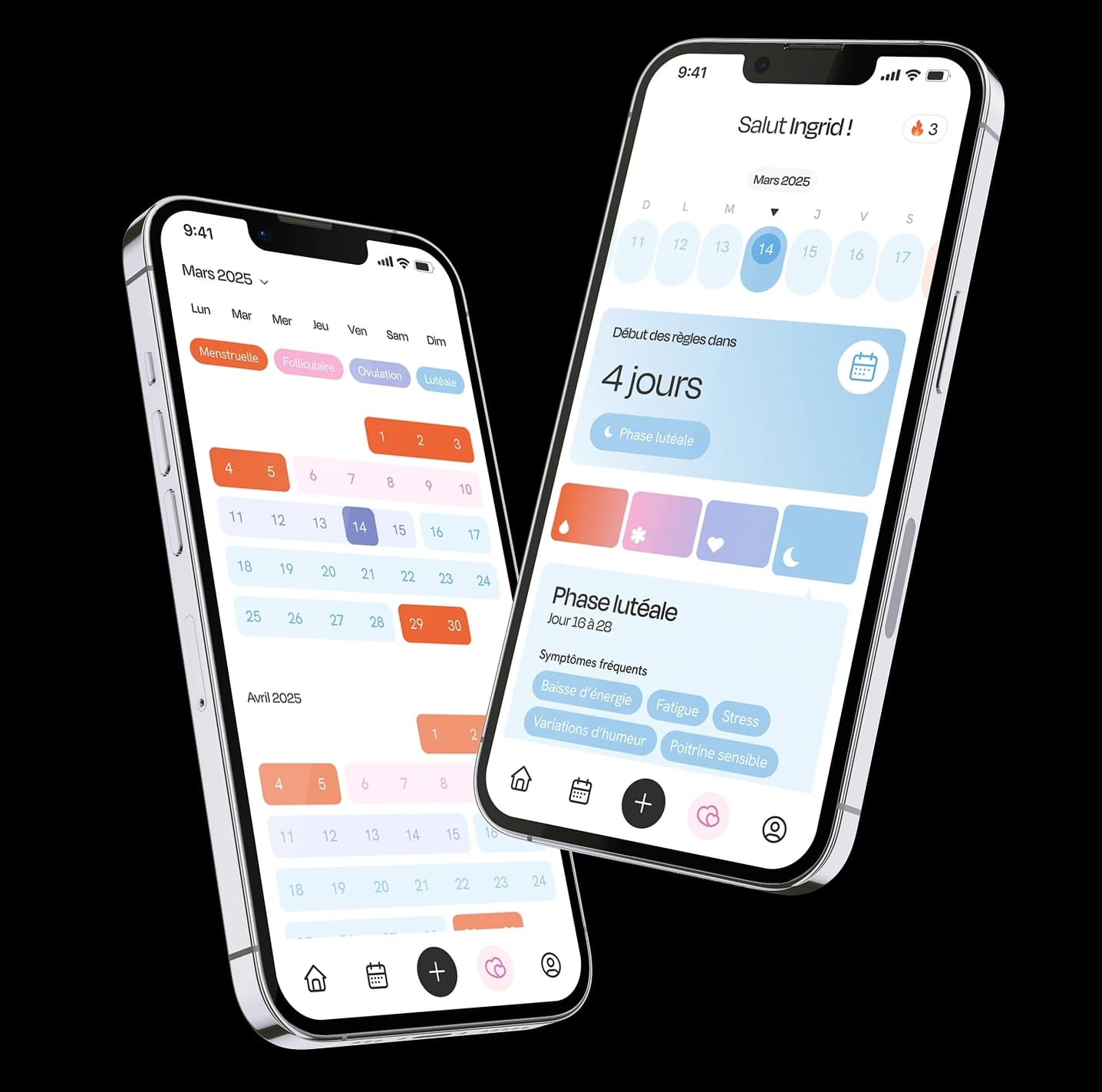
Wenly : The cycle tracking app for couples
It was with this in mind that Wenly was created : the first French menstrual cycle tracking app designed with the couple in mind. Wenly makes it easy to track your cycle, understand its phases and associated symptoms, and share key information with your partner without having to explain every detail.
The goal is clear: to transform menstrual tracking into a tool for mutual understanding and communication.