

Couple
Desire and Libido Across the Cycle: What Hormones Change (and What They Don't)
Libido often shifts with the phases of the cycle. Understanding this link to better navigate desire, alone and as a couple.

Some days, wanting is obvious. Other days, it seems to vanish for no clear reason. If you've noticed your desire shifting over the month, it's neither in your head nor a sign that "something's wrong" with your relationship. Libido is largely shaped by the hormones of the menstrual cycle, which change throughout the phases of the cycle.
This article explores the link between cycle and desire: what hormonal patterns tend to show up, why they don't tell the whole story, and how to talk about it as a couple without pressure or misunderstanding.
Three hormones, three different effects on desire
Sexual desire isn't driven by a single hormone, but by the shifting balance between several:
Oestrogen tends to boost desire and support lubrication. Levels climb through the follicular phase and peak just before ovulation.
Testosterone, also present in women in small amounts, supports arousal and sexual motivation. It follows a curve fairly close to oestrogen's.
Progesterone, dominant after ovulation, tends to have a calming, sometimes sedative effect, which can come with a dip in desire for some women.
This interplay explains why desire isn't constant from one day to the next: it partly follows the hormonal mechanics of the cycle.
What the patterns suggest, phase by phase
Several studies on the topic note a recurring pattern, even though the intensity varies enormously from one woman to another:
During your period, oestrogen and progesterone drop sharply, which can unmask testosterone's effect for some, sparking an unexpected rise in desire, while others mainly feel discomfort.
In the follicular phase, rising oestrogen often comes with growing desire, alongside rising energy.
Around ovulation, desire frequently peaks, carried by the high point of oestrogen and testosterone.
In the luteal phase, progesterone's dominance often comes with a dip in desire, sometimes amplified by premenstrual syndrome (PMS) symptoms late in the cycle.
These patterns remain averages observed across groups of women, not a rule that applies to everyone. Some notice no meaningful variation at all; others follow a very different pattern.
Hormones don't tell the whole story
Reducing libido to a simple hormonal curve would be misleading. Sleep, stress, fatigue, the quality of the relationship and life circumstances weigh just as much, if not more. A stretch of intense work stress, for instance, can wipe out the expected desire peak around ovulation entirely.
Hormonal contraception plays a role too: by stabilising hormone levels across the cycle, some pills dampen these natural variations, more or less depending on the woman.
In other words, noticing a link between your cycle and your desire can be illuminating, but it's never the whole explanation.
Talking about it as a couple, without pressure
Understanding these variations can shift a couple's dynamic, as long as it doesn't become a rigid calendar to follow. The goal isn't to "schedule" intimacy around the cycle, but to understand each other better.
Knowing that desire can naturally fluctuate helps put a temporary dip in perspective, rather than reading it as personal rejection. Conversely, it can also explain a sudden rise in wanting at certain moments. Either way, talking about it openly, without judgment, beats interpreting it in silence.
When desire stays away for a long time
A dip in libido that follows the rhythm of the cycle is one thing. A prolonged absence of desire, that no longer varies and weighs on daily life, is another. It can have many causes: chronic fatigue, stress, relationship tension, certain treatments, or a deeper hormonal cause. In that case, talking to a doctor, a gynaecologist or a sex therapist can help bring clarity.
Frequently asked questions
Does libido really change with the cycle?
Patterns are observed: desire is often stronger around ovulation and lower late in the luteal phase. But how much it varies differs a lot from one woman to another.
Why does my desire drop before my period?
Progesterone's dominance in the luteal phase often has a calming effect that can come with a dip in desire, sometimes amplified by PMS symptoms.
Does the pill affect libido?
It can, in either direction, by stabilising the cycle's natural hormone levels. The effect varies by woman and by type of contraception.
Should I worry about a drop in desire?
A temporary dip linked to the cycle, stress or fatigue is normal. A prolonged absence of desire that affects your wellbeing is worth discussing with a professional.
How do I talk about it with my partner?
By simply naming what you're feeling, without trying to justify everything. Understanding that desire fluctuates naturally helps defuse misunderstandings.
Understanding your body better also means understanding your wants better. With Wenly, you can track your cycle phases and share these markers with your partner, to navigate desire with more closeness and fewer misunderstandings.

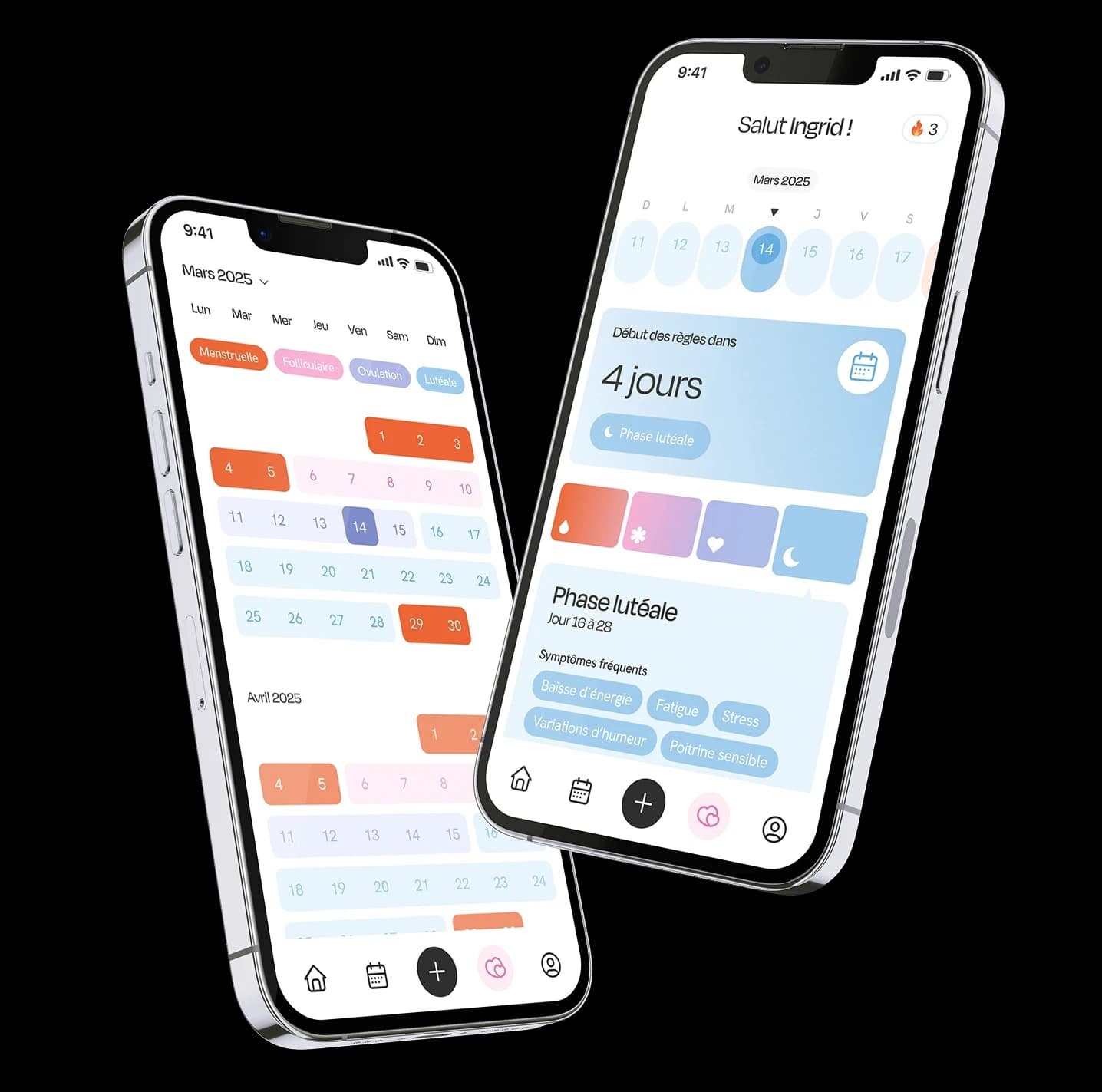
Wenly : The cycle tracking app for couples
It was with this in mind that Wenly was created : the first French menstrual cycle tracking app designed with the couple in mind. Wenly makes it easy to track your cycle, understand its phases and associated symptoms, and share key information with your partner without having to explain every detail.
The goal is clear: to transform menstrual tracking into a tool for mutual understanding and communication.