

Menstrual cycle
The 4 Phases of the Menstrual Cycle, Simply Explained
Period, follicular phase, ovulation, luteal phase: understand the 4 phases of the menstrual cycle and the role of hormones, jargon-free.
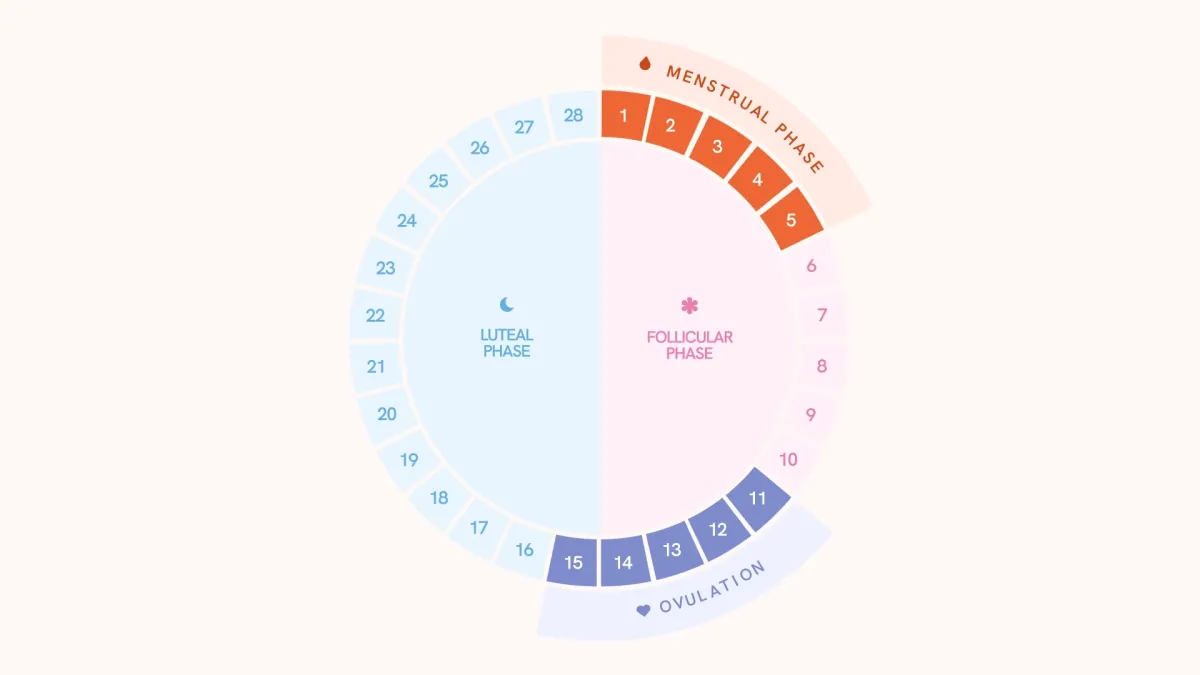
We often reduce the menstrual cycle to the period. Yet that's only one part of a much richer sequence, orchestrated by hormones throughout the month. Understanding the phases of the menstrual cycle means understanding your body better: its energy, its moods, its fertility, and those little signals that come back at specific moments.
This article describes the 4 phases of the cycle, without needless jargon: what happens at each stage, which hormones are in charge, and why knowing this rhythm helps you both live your cycle and share it as a couple.
What is the menstrual cycle, exactly?
The menstrual cycle is the time from the first day of one period to the first day of the next. Its average length is 28 days, but anything between 21 and 35 days is considered normal, according to the MSD Manual. It's driven by a constant dialogue between the brain and the ovaries, through several hormones: FSH and LH (produced by the pituitary gland), and oestrogen and progesterone (produced by the ovaries).
This cycle is classically divided into four phases that follow one another: the period, the follicular phase, ovulation and the luteal phase.
Phase 1: the period (menstrual phase)
The cycle begins, by convention, on the first day of your period. With no pregnancy in the previous cycle, the womb lining (the endometrium), which had thickened, breaks down and is shed: that's your period. According to the NHS, it usually lasts 3 to 7 days.
This is when hormone levels are at their lowest. Many women feel a dip in energy during this time, which is perfectly normal. Unusually painful or heavy periods, however, are worth raising with a professional.
Phase 2: the follicular phase
It starts on the first day of your period and continues until ovulation. Under the effect of FSH, several follicles develop in the ovary, but only one becomes dominant. This follicle produces increasing amounts of oestrogen, which gradually thickens the endometrium to prepare for a possible pregnancy, as described by the MSD Manual.
This is often a phase where energy rises. The climb in oestrogen frequently comes with renewed drive and a sense of wellbeing. Its length is the most variable part of the cycle: it's what makes a cycle shorter or longer from one person to another.
Phase 3: ovulation
Around the middle of the cycle, the sharp rise in oestrogen triggers a surge of LH. According to the NHS, this LH surge signals that ovulation is about to happen, usually within 12 to 24 hours. The ovary then releases an egg, which only remains fertilisable for about 12 to 24 hours.
This is the most fertile time of the cycle. Because sperm can survive several days, the fertile window actually spans a few days around ovulation. Some women feel a slight pain on one side of the lower abdomen, or notice clearer, more abundant cervical mucus.
One important point: ovulation doesn't always happen "on day 14." The NHS notes it most often happens 10 to 16 days before the next period: that marker is an average, not a rule, and the day of ovulation varies with the length of the cycle.
Phase 4: the luteal phase
After ovulation, the empty follicle turns into the corpus luteum, which secretes progesterone. This hormone keeps the endometrium thick and ready to receive an embryo. Without fertilisation, the corpus luteum breaks down, hormone levels drop, and the period arrives, marking the start of a new cycle.
The luteal phase is more stable than the follicular phase: according to the MSD Manual, it lasts about 14 days (between 9 and 16 days). It's also during this phase, with the hormonal drop at the end, that premenstrual syndrome (PMS) appears in many women.
Why knowing your phases changes everything
Knowing your phases isn't theoretical knowledge: it's an everyday tool. It helps you understand why energy, mood or libido shift over the month, anticipate the more sensitive days, and spot what falls outside the ordinary, such as a late period or persistently irregular cycles.
It's also a great anchor for the couple. When your partner understands this rhythm, it becomes easier to navigate the highs and lows of the cycle together, without enduring or misreading them. Tracking your phases as a couple turns something often experienced alone into genuinely shared knowledge.
Frequently asked questions
What are the 4 phases of the menstrual cycle?
The period (menstrual phase), the follicular phase, ovulation and the luteal phase. They follow one another from the first day of one period to the next.
How long does each phase last?
The period lasts 3 to 7 days, the follicular phase is variable, ovulation lasts about 24 hours, and the luteal phase lasts around 14 days (between 9 and 16 days).
When does ovulation happen?
Around the middle of the cycle, but not necessarily on day 14. The exact day depends on the length of the cycle and can vary from month to month.
Which hormones regulate the cycle?
Mainly FSH and LH (produced by the brain), along with oestrogen and progesterone (produced by the ovaries).
Why does my energy change over the cycle?
Because hormone levels vary by phase: energy often rises in the follicular phase, while the end of the luteal phase, marked by a hormonal drop, can come with fatigue or irritability.
Sources: MSD Manual — NHS
Understanding your cycle is the first step; tracking it day to day is the second. With Wenly, you can see your phases, anticipate the key moments and share that tracking with your partner, to live your cycle together rather than each on your own side.

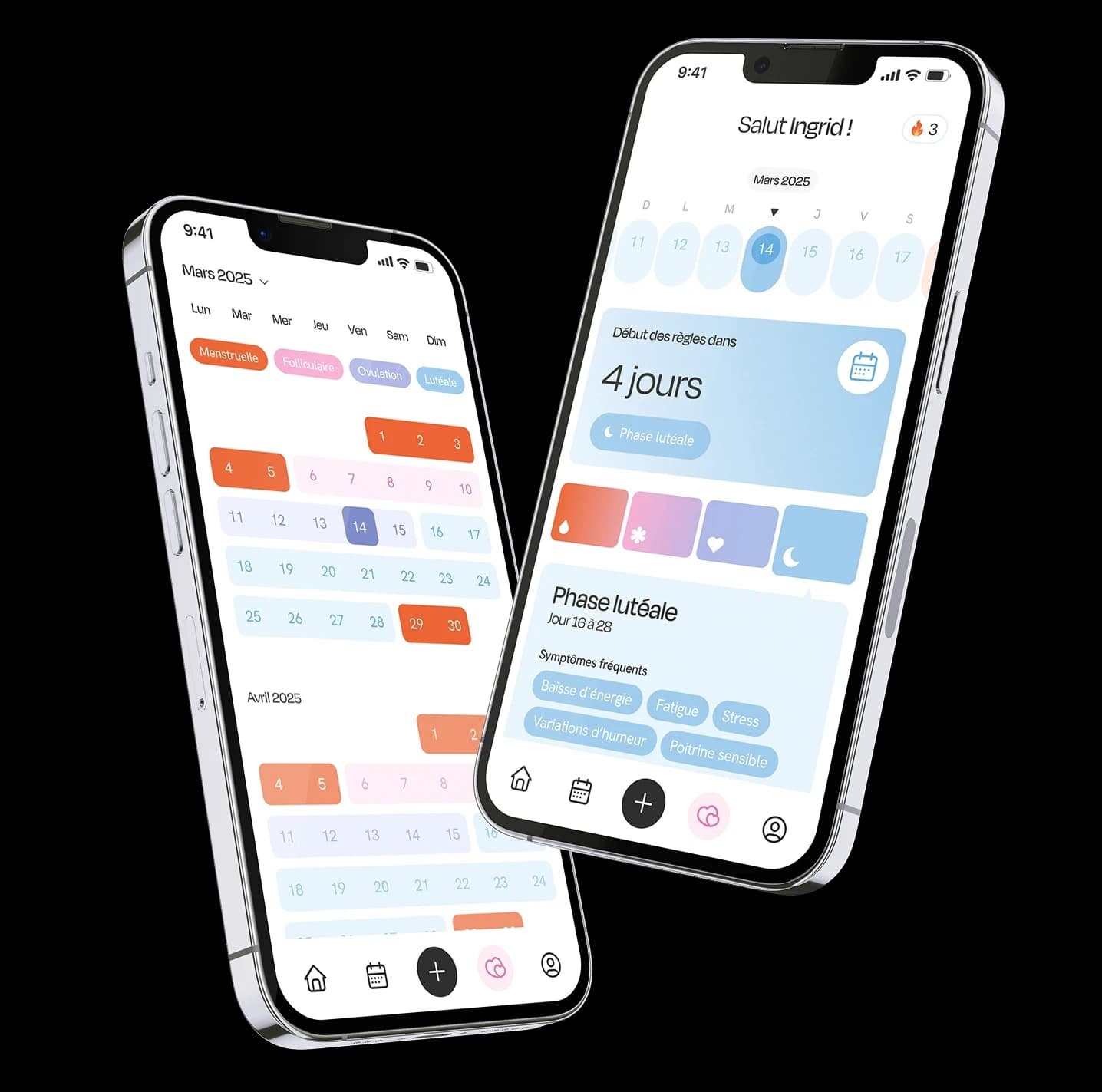
Wenly : The cycle tracking app for couples
It was with this in mind that Wenly was created : the first French menstrual cycle tracking app designed with the couple in mind. Wenly makes it easy to track your cycle, understand its phases and associated symptoms, and share key information with your partner without having to explain every detail.
The goal is clear: to transform menstrual tracking into a tool for mutual understanding and communication.